Pocket Option Broker is a Finance-category mobile app built around a single purpose: giving retail traders access to short-term contracts on more than 150 assets from wherever they happen to be. Published under the name ITTrendex, LLC, it describes itself as the fastest growing broker of 2017-2019, which tells you something about the period it grew up in, when mobile-first trading platforms were multiplying fast.
The app is free to install and mirrors the functionality of the browser platform. What you get is a chart, an asset list, an expiry selector, a stake field, and a pair of directional buttons. That is the core loop, and the app does not try to disguise it behind extra layers.
Everything else in the product exists to support that loop. Training materials, daily market analysis, trading signals, built-in indicators, and prepackaged trading strategies sit alongside the trading screen rather than in a separate learning silo.
What Sits Inside That 150+ Asset List
The asset count is the number most people notice first, though what matters is what it represents in practice. Pocket Option groups instruments across stock and commodity markets, which means a single account can move between very different underlying products without changing platforms.
That breadth matters more for schedule reasons than for diversification reasons. Different markets have different active hours, so a trader who only has evenings free is not stuck staring at an instrument that has gone quiet.
The platform advertises quotes sourced from liquidity providers, delivered without requotes or delays. In practice this is the claim every broker makes, and the honest way to evaluate it is to watch how the price behaves during high-volatility windows rather than during a calm midday session.
Stable communication around the clock, seven days a week, is another stated feature. Weekend availability is a real differentiator in this corner of the market, since a portion of the asset list stays tradable when traditional exchanges are closed.
The Learning Layer: Signals, Indicators, and Daily Analysis
A lot of trading apps bolt on an education tab and forget about it. Pocket Option puts its analytical support in the same place you place trades, which changes how it gets used.
The built-in indicators are the most immediately useful piece. Rather than exporting a chart to a separate charting service, you apply moving averages, oscillators, or trend tools directly to the asset you are watching.
Trading signals and daily analysis are the more contentious features. They are useful as a prompt to look at something you had not considered, and they are a poor substitute for your own reasoning. Anyone treating signals as instructions is going to have a rough time regardless of which broker provides them.
The training materials fill a genuine gap for people arriving with no background. Terminology around expiry, payout percentages, and position sizing is not intuitive, and having it explained inside the app removes an excuse for skipping it.
The Kind of Trader Pocket Option Attracts
The user base skews toward retail traders working with modest account sizes who want short-duration exposure without the margin mechanics of CFDs or futures. The barrier to entry is low, which is both the appeal and the risk.
Broadly, the people who get the most out of the platform fall into a few groups:
- Newcomers using the demo mode and training materials to learn how order mechanics work before committing capital
- Part-time traders who follow specific commodity or index moves around a day job
- Experienced traders running the app as a secondary tool alongside a primary brokerage account
- People testing indicator-based strategies on a small stake before scaling them elsewhere
What unites them is a preference for a platform that does not demand a lot of setup. That is a legitimate need, and it is also why the risk warnings around this product category deserve attention. Short-expiry trading has a high loss rate among retail participants, and no amount of built-in analysis changes that arithmetic.
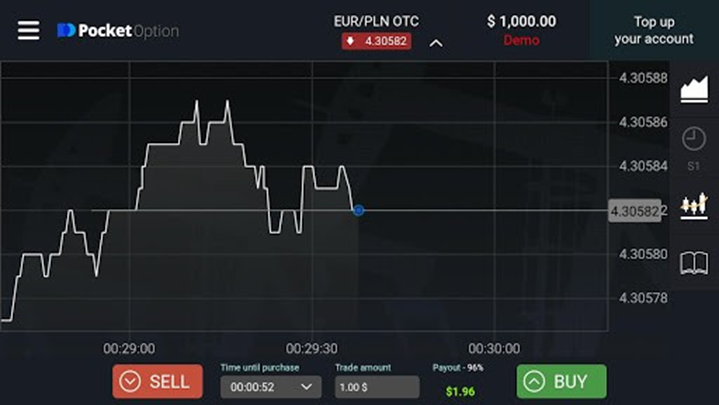
Chart Reading on a Phone Versus a Monitor
Here is where the desktop question becomes practical rather than theoretical. The Pocket Option interface is compact by necessity on a phone: the chart occupies maybe two-thirds of the screen, the asset list is a slide-out panel, and stacking three indicators on a five-inch display quickly turns into a mess of overlapping lines.
On a monitor, the same layout breathes. You can read a full session of candles instead of scrolling backward, keep the indicator panel visible while the chart stays legible, and see the expiry countdown without it competing for space with the stake field.
Multitasking Around the Trade
Screen size is only half of it. Most traders are not looking at one thing. They have an economic calendar open, a news feed running, maybe a spreadsheet tracking results.
A phone forces you to swap between apps, and swapping away from a live position with a two-minute expiry is exactly when you miss something. On a desktop, the trading window sits in one corner while everything else stays visible.
For anyone who wants that setup, the usual route is running the Android build through an emulator like BlueStacks, since that keeps the actual mobile interface instead of forcing a browser tab to imitate it; the guide to download Pocket Option Broker for PC walks through that install. The tradeoff is that you are working with a touch interface adapted to mouse input, so the tap targets feel oversized on a large display.
What Changes About the Controls
Mouse input is more precise than a thumb for placing indicator levels and adjusting stake amounts. It is also slower for the actual entry, since a tap is faster than a click when you have already decided.
Traders who care about entry speed on very short expiries sometimes find the phone better for execution and the desktop better for analysis. Using both is common, and account state syncs regardless of which one you opened last.
Getting the Account Ready Before You Trade Real Money
Start with the demo balance. It exists specifically so you can learn where the buttons are and how payouts are calculated without paying tuition to the market. Once real capital is on the line, a few habits are worth building into the routine:
- Check the payout percentage on every asset before entering, not after; it varies by instrument and time of day, and a rate that looks fine on one asset can be worse on another at the same moment
- Read the withdrawal terms for your deposit method, including processing times and any turnover requirements tied to bonus funds, since those requirements can lock up a balance right when you want it out
- Confirm the regulatory status and account terms that apply in your own country before funding anything, since availability and the applicable rules differ by jurisdiction
None of that changes how the platform itself works. It just decides whether the numbers on your screen match what actually lands in your account when the trade closes.